

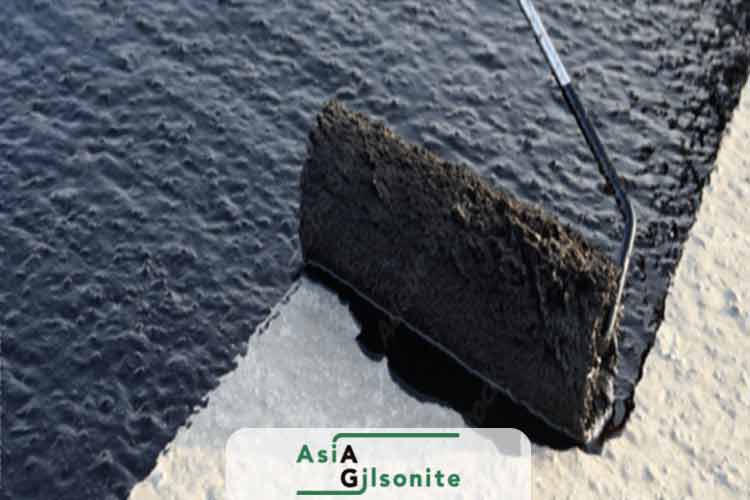
Gilsonite is not coal tar or wood tar. It is a naturally occurring solid asphaltite, commonly described as natural bitumen. Asia Gilsonite produces and exports Gilsonite in lump and powder forms; this article explains the terminology so industrial buyers can specify the right material. For our product and supply information, start with Asia Gilsonite.
Tar, Bitumen and Gilsonite: What Is the Difference?
These materials can look dark and share some binding or protective uses, but their origin, composition and handling requirements differ. Similar appearance does not establish equivalence, and one material should not be substituted for another without formulation and application testing.
| Material | Origin and form | Relevance to industrial selection |
|---|---|---|
| Tar | Produced by the destructive distillation or carbonization of organic feedstocks, such as coal or wood. | Specify the feedstock, intended use and safety documentation. Coal tar and wood tar are not Gilsonite. |
| Petroleum bitumen | A petroleum-derived binder obtained through refining. | Binder grade and performance requirements govern selection for paving and other formulations. |
| Gilsonite | A naturally occurring solid asphaltite supplied as lumps or processed powder. | Evaluate grade, particle size and compatibility for use as a modifier or additive. |
| Asphalt mixture | A designed combination of aggregate and binder. | Gilsonite may be evaluated within the binder or mixture; it is not the complete paving mixture. |
For a closer comparison of the binder and natural material, see bitumen versus Gilsonite.
Why the Word “Tar” Can Cause Confusion
In informal descriptions, people sometimes call a black paving or waterproofing material “tar” without identifying its chemistry. A purchase specification needs more precision. Coal tar, tar-derived pitch, petroleum bitumen and natural Gilsonite should not be treated as interchangeable names.
Pitch can refer to a residue from particular processing routes; its source must be stated. Roofing felt is a finished material rather than a synonym for tar. Similarly, describing a paving product as “tar-based asphalt” does not establish that it contains Gilsonite or that it meets a project’s requirements.
When Is Gilsonite Relevant to Your Application?
Gilsonite for Asphalt Modification
Gilsonite can be evaluated as a modifier in compatible petroleum-bitumen binders and asphalt mixtures. Performance depends on the base binder, Gilsonite grade, particle size, dosage, dispersion and project mix design. There is no universal addition rate or guaranteed improvement for every mixture. Review Gilsonite for asphalt pavement for selection and testing considerations.
Gilsonite for Drilling and Other Industrial Formulations
The correct material must match the intended formulation and operating conditions. Use our Gilsonite applications guide to find the relevant drilling or industrial application, rather than specifying generic tar for a job that calls for Gilsonite.
Lump Material or Gilsonite Powder?
The required delivery form depends on the buyer’s processing and mixing route. Particle-size requirements should be stated explicitly, including the mesh or micron specification and the applicable measurement method. Our Gilsonite powder guide explains the role of particle size in material selection.
What to Include in a Gilsonite Enquiry
- The application and base formulation.
- Required lump or powder form and particle-size specification.
- Required ash, softening characteristics and other acceptance limits.
- Order quantity, packing requirements and delivery destination.
- Required laboratory reports and safety documentation.
Review the Gilsonite specifications and laboratory information before placing an enquiry. Published information is a starting point; available grade, sample results and acceptance limits should be confirmed for the actual supply.
Buying the Correct Material
Asia Gilsonite’s product focus is natural Gilsonite, not coal tar or wood tar. If your specification names tar, clarify the material with your technical team before ordering. If it calls for natural Gilsonite or Gilsonite powder, contact Asia Gilsonite with the application, grade, quantity and destination so the enquiry can be assessed against the correct product.
This article provides material-selection guidance. It does not recommend medicinal use or establish that any material is safe for a particular application; consult the relevant safety data and project requirements.
Technical References
- Asphalt Institute and Eurobitume: The Bitumen Industry – A Global Perspective, for petroleum bitumen and natural asphalt terminology.
- IARC monograph glossary, for the distinction between coal tar and bitumen.
Thank you for this excellent explanation and specifications.
Its My Pleasure
Where can I buy lump coal tar for roofing?Noel