
Gilsonite can be used as a natural asphalt modifier, but its value must be judged against the base binder, aggregate, dosage, climate, traffic and mix design. The most defensible benefits of Gilsonite in asphalt pavement are changes that can be measured in a laboratory trial and confirmed during plant production. This guide explains what may improve, what must be tested, and how to select a consistent material.
For the complete application overview, start with our Gilsonite for asphalt pavement page. For project planning and production considerations, also see Gilsonite in road construction.
What Gilsonite Can Change in an Asphalt Mix
Gilsonite is a naturally occurring solid hydrocarbon, also called natural bitumen, asphaltite or uintaite. When it is compatible with the selected binder and mixed correctly, it can change binder consistency and mixture response. These changes are the basis for the potential performance benefits described below.
Higher binder stiffness at elevated temperatures
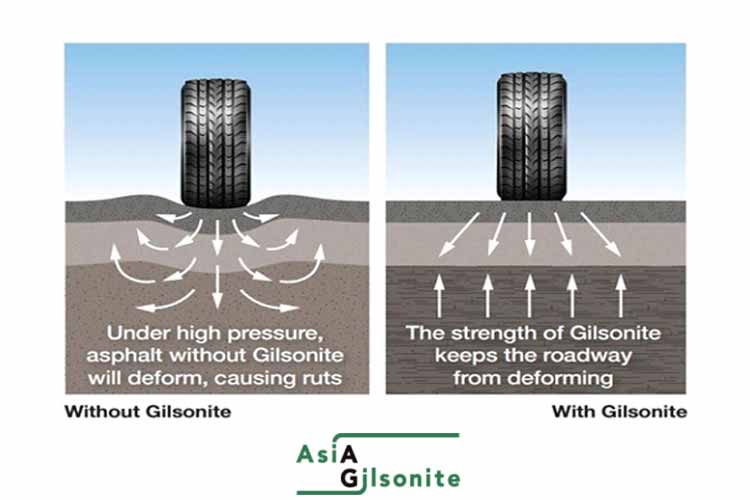
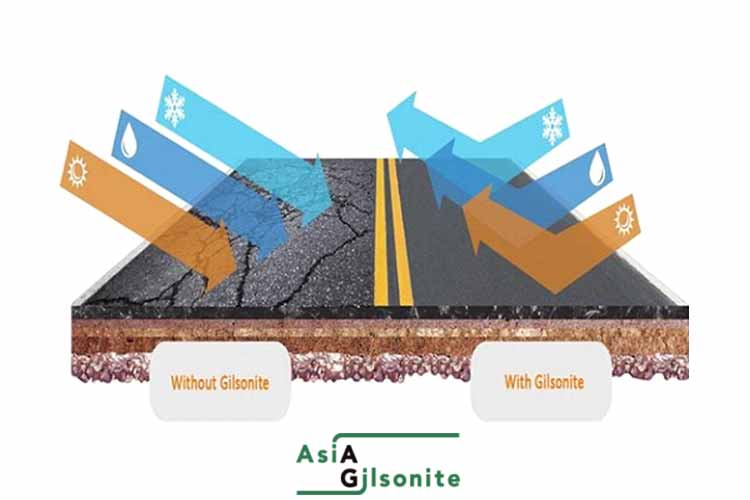
Gilsonite commonly increases binder consistency and may improve high-temperature response. In a suitable mix, this can support resistance to permanent deformation and rutting. The result depends on dosage and compatibility; excessive stiffening can create other risks and should not be assumed to be beneficial.
Potential improvement in rutting resistance
A stiffer modified binder can help the asphalt mixture retain shape under heavy loading and hot pavement temperatures. Wheel-tracking or another project-approved mixture test should compare the control mix with the proposed Gilsonite-modified mix.
Adjustment of viscosity and softening behaviour
Gilsonite may increase viscosity and influence softening behaviour. These effects can be useful when a project requires a harder or more temperature-resistant binder, but they also affect mixing and compaction temperatures. Plant settings should therefore follow trial results rather than a universal recipe.
Possible changes in adhesion and moisture response
Some formulations may show better binder-aggregate interaction or moisture resistance. Aggregate mineralogy and the presence of anti-stripping agents can strongly affect the outcome. Moisture susceptibility must be tested with the actual project materials.
Benefits That Require Project-Specific Evidence
Claims about longer service life, less cracking, lower maintenance cost, better skid resistance, lower noise or environmental performance cannot be guaranteed from the additive name alone. Low-temperature and fatigue cracking may improve, remain unchanged or worsen depending on binder grade and dosage. Surface friction is controlled mainly by aggregate and pavement texture. Environmental claims require a defined life-cycle comparison.
For this reason, Gilsonite should be treated as an engineering input, not as an automatic performance guarantee. A successful design balances high-temperature stability with low-temperature and fatigue requirements.
How to Validate Gilsonite for an Asphalt Project
Prepare a control binder and control mixture, then compare them with one or more Gilsonite dosages. The test program should follow the project specification and local method, and normally considers:
- binder consistency, softening point or performance grade;
- viscosity and workable mixing and compaction temperatures;
- high-temperature deformation or rutting response;
- low-temperature and fatigue-cracking response where required;
- moisture susceptibility and aggregate compatibility;
- volumetric properties, stability and production consistency.
The selected dosage is the level that meets the complete specification, not simply the level that produces the highest stiffness. More background on terminology is available in Is Gilsonite asphalt? and our bitumen vs Gilsonite comparison.
Material Quality Matters
Two Gilsonite supplies can differ in softening point, ash, moisture, particle size and chemical composition. Those differences can affect dispersion and repeatability. Buyers should define the required grade, powder size and acceptance limits, then verify each shipment with a certificate of analysis and, when necessary, independent testing.
Review our Gilsonite laboratory specifications, analysis guidance and Gilsonite powder guide before selecting material for a trial.
Practical Conclusion
The main potential benefits of Gilsonite in asphalt pavement are measurable changes in binder stiffness, high-temperature response and mixture deformation resistance. The final pavement benefit depends on the full design and must be demonstrated with the project binder, aggregate and test requirements. Asia Gilsonite can provide grade information and samples for evaluation; contact our team with the target specification, application and required particle size.